


Zoom Japan: Colors of Japan – Senses of Japan (lecture 5/2026)
Tue Sep 22, 2026, 7:00 pm
Language of the lecture: German – 5th lecture of the lecture series (previous lectures: Feb 24, Apr 28, Jun 16 + Jul 21, 2026; future lecture: Nov 24, 2026). – The lectures each have a different content.
Diverse natural landscapes and distinct seasons with their corresponding color palettes have shaped Japan since ancient times and influenced the aesthetic sensibilities of its inhabitants. From China, Japan adopted the concept of the “five colors” (goshiki) – red, blue, yellow, white, and black – based on the Yin-Yang philosophy and their connection to the five elements. Inspired by the beauty and transience of nature, specific color shades were frequently named after plants or animals and celebrated in poetry. This led to the development of the “traditional colors of Japan” (Nihon no dentō-shoku) with a broad spectrum of shades that continue to be referenced and used to this day.
Colors served, among other purposes, to indicate court rank and social hierarchy; certain shades – similar to purple in the West – were reserved for specific groups or social classes. During the Heian period (794-1185/1192), the tasteful color combination of the various layers of a court robe was regarded as an expression of sophistication and elegance; even in the 21st century, this concept remains palpable when coordinating accessories to complement a kimono. Beginning in the Edo period (1603–1868), new colors, dyeing techniques, and manufacturing methods opened up additional creative possibilities. Colors appeal to the senses, convey emotions and messages, and are encountered throughout Japan in religion and literature, art and crafts, everyday life, and many other areas.
In this continuation of the online lecture series launched in the first half of 2026, additional traditional Japanese colors will be presented – exploring their origins, significance, and usage – and illustrated through numerous visual examples to trace their enduring impact right up to the present day. – While the lectures build upon one another, they can also be attended individually without any prior knowledge. Participation is free of charge; registration via email is required, after which you will receive the corresponding Zoom link 1–2 days prior to the respective session.
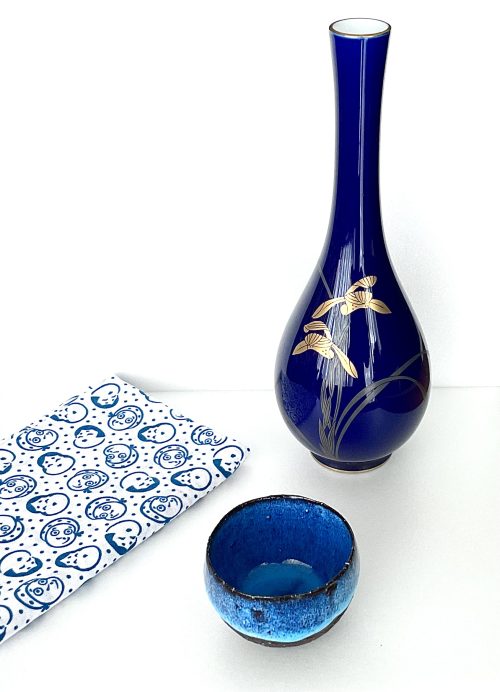
Ill.: Blue in various variations—depicted as an elegant blue accented with gold (a Kōransha vase featuring an iris motif), a glazed sake cup, and a patterned cotton cloth (tenugui). Photo © Ruth Jäschke